

24 straight answers about quotations, performance, regulations, guarantees and installation — organised by topic. Can't find yours? Ask us directly below.
01 — 4 questions
Quotes & Ordering
How quotations work, what to send us and how to place an order.
How do I get a quote for my project?
Send us your approximate sizes, drawings or an architect's schedule through the quote form, and we'll return a detailed, itemised quotation — usually within 2–3 working days, free of charge and without obligation. Photos of the existing openings help too. If anything is unclear we'll call you before pricing, so the quote you receive is one you can rely on.
Is the quotation really free — and is there any obligation?
Yes — every SIVAL quotation is free and carries no obligation. You'll receive a written breakdown covering each opening, the system specified, glazing, finish and lead time. The quote stays valid for 60 days, and we're happy to revise it as your design develops or your budget firms up.
What information should I include for the most accurate price?
The essentials are width and height for each opening (to the nearest 10mm is fine at quote stage), whether it's a new build or replacement, your preferred colour or finish, and the site postcode. Anything extra — elevation drawings, glazing preferences, security requirements — sharpens the price further, but don't wait until everything is final: quotes can be refined at survey.
Can I order directly, or do I need a builder or installer?
Both routes work. Homeowners can order supply-only and have their own builder fit the systems, or we can connect you with an approved SIVAL installation partner near you. Trade customers and fabricators order directly through our trade desk with fabrication support, cutting lists and technical drawings included.
02 — 4 questions
Windows & Doors
Choosing casements, tilt-turns and entrance doors — styles, sizes and security.
Which window style should I choose — casement or tilt-turn?
Casements (side-hung, opening outwards) suit most UK homes and give clean, familiar sightlines. Tilt-turns open inwards for safe cleaning and secure night-time ventilation, which makes them ideal for upper floors and apartments. Both are available across our thermally broken window systems, so the choice is about how you'll live with them rather than performance.
How secure are aluminium entrance doors?
Very. Our entrance door systems are tested to PAS 24 with multi-point automatic locking, laminated glazing options and 3D-adjustable concealed hinges. For entrance doors, see our SV-6000 Porta range in Premium, Comfort and Classic design lines. Aluminium's inherent strength means the door leaf itself resists twisting and forcing far better than uPVC.
What colours and finishes are available?
Any RAL shade, plus anodised tones and textured woodgrain effects — powder-coated to a minimum 60-micron architectural standard with marine-grade options for coastal homes. Dual-colour is available on most systems, so the inside can differ from the outside (for example, white inside with an anthracite exterior).
Can you match a heritage or steel-look style in aluminium?
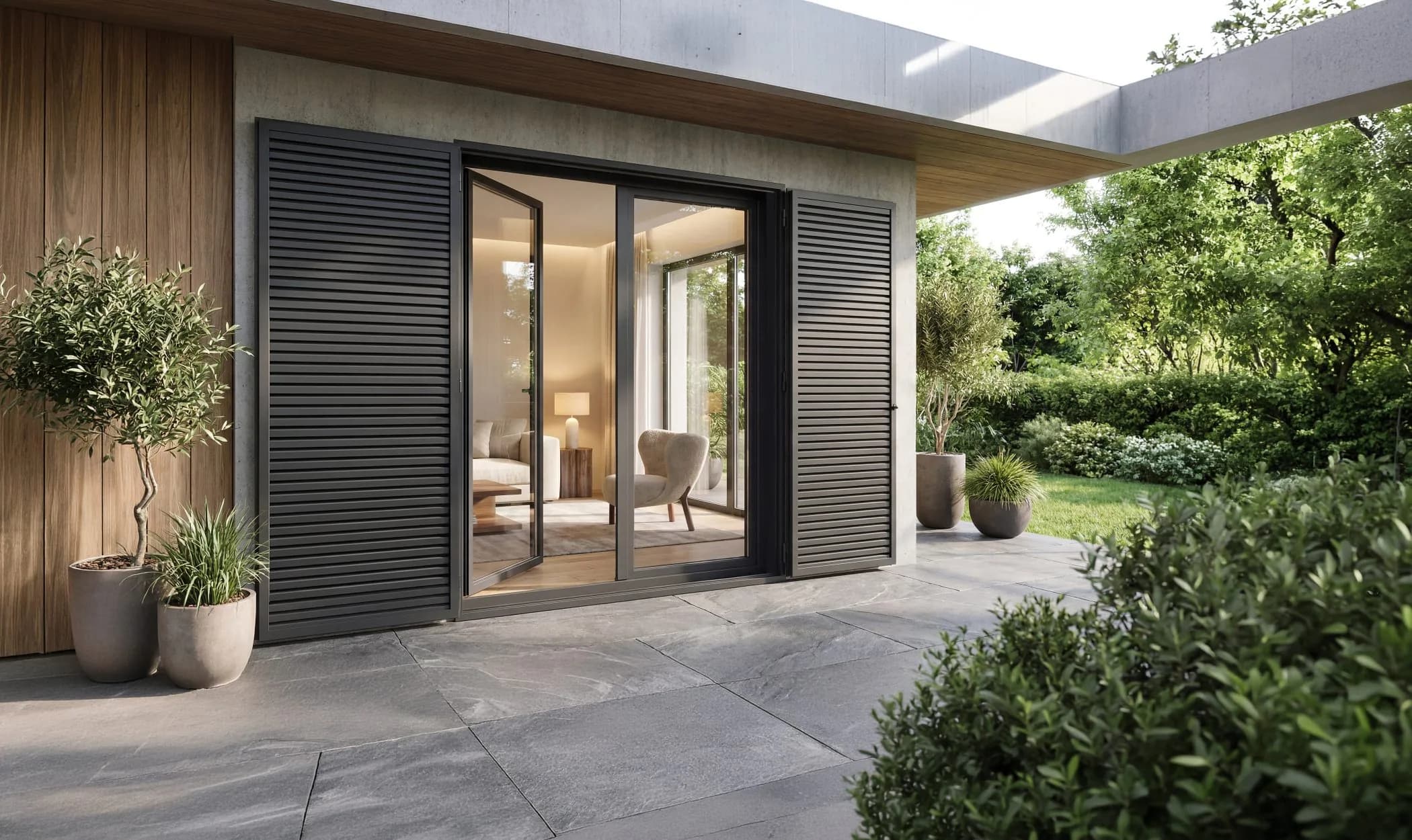
Yes. The SV-6000 Urban recreates the classic steel-framed 'Crittall' aesthetic with slim flat profiles and authentic glazing bars, while the Classic line of our SV-6000 Porta entrance doors and our Traditional Door Panels offer panelled designs inspired by traditional timber doors — all with modern thermal breaks and none of the upkeep of steel or timber.
03 — 4 questions
Sliding & Bi-fold
Lift-and-slide, minimal sliders and bi-folding doors for open living.
Bi-fold or sliding doors — which is right for my extension?
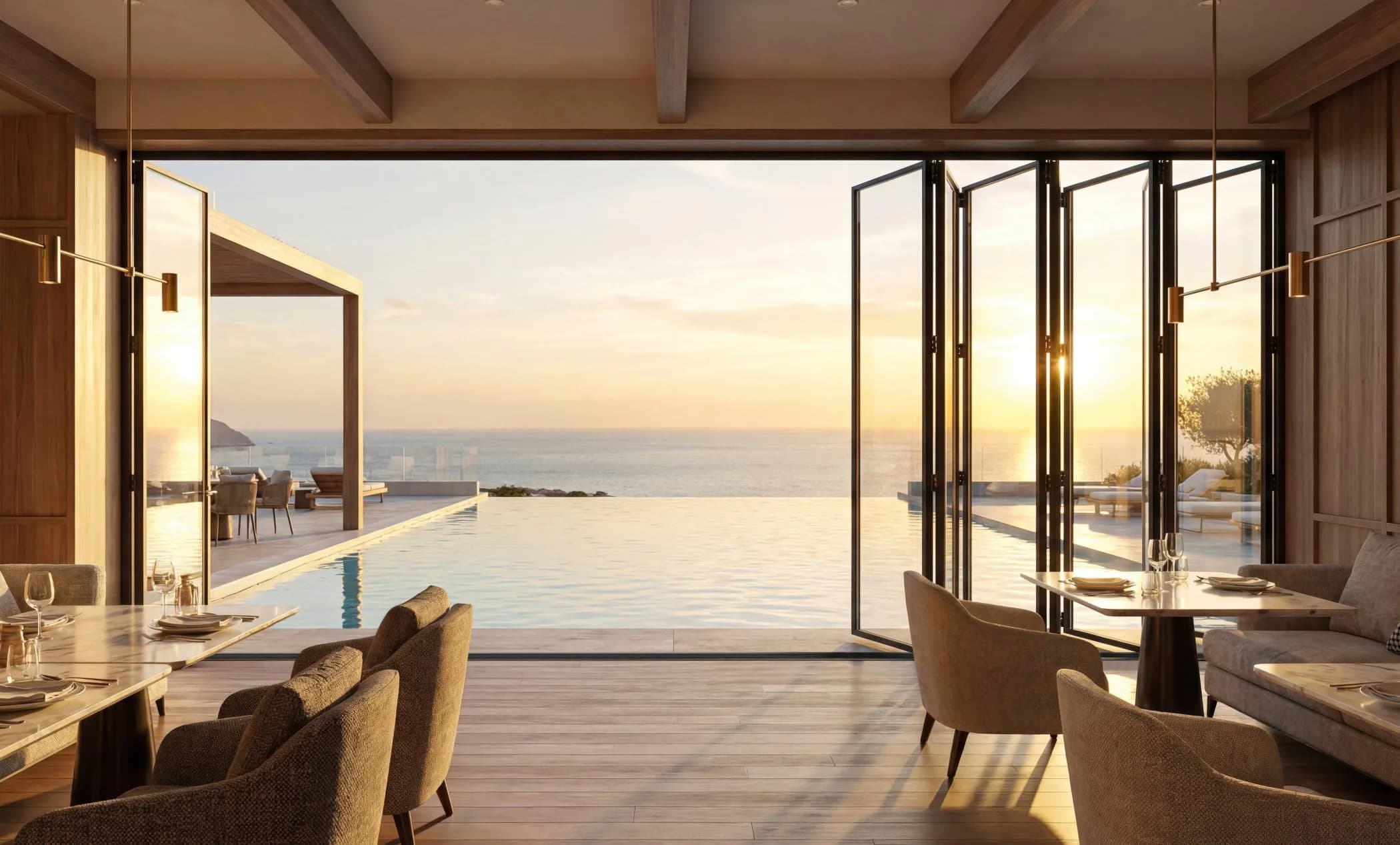
Choose bi-folds if you want the whole wall to open — panels concertina flat against the reveal for a completely clear opening. Choose sliders if your priority is glass area and views: panels are larger, sightlines slimmer (down to 26mm with the SV-3600 Minimal), though part of the opening is always occupied by a panel. Many projects combine both.
How big can a single sliding panel be?
Very big. The SV-3600 Minimal carries individual sashes up to 12m² and 1,000kg — panels three metres tall are routine — while the SV-8800 Lift Slide manages leaves up to 400kg with a rise-and-glide action that seals under compression. At survey we check structural support and access so oversized glass can actually reach your opening.
Are level thresholds possible for step-free access?
Yes — our sliding and bi-folding systems offer recessed low thresholds that finish flush with the internal floor, with concealed drainage handling the weather outside. These meet Part M accessible-entry requirements and are ideal for family kitchens, wheelchair access and simply avoiding a trip edge between inside and out.
Can sliding doors be motorised?
The SV-3600 Minimal supports fully concealed motorisation with app, switch or smart-home control, including soft-start, obstacle detection and battery backup. Even a one-tonne glass wall opens at the touch of a button. Manual operation remains effortless on all our sliders thanks to stainless tracks and precision tandem rollers.
04 — 4 questions
Performance & Regulations
U-values, thermal breaks, Part L, PAS 24 and the numbers behind the specs.
What U-value do I need to meet Building Regulations?
For replacement windows and doors in England, Part L currently requires a whole-window Uw of 1.4 W/m²K or better; new-build limits are set through the dwelling's overall energy calculation. SIVAL thermally broken systems achieve 0.9–1.4 W/m²K depending on glazing, so compliance is comfortable — and we provide per-project U-value reports as evidence.
What is a thermal break and why does it matter?
A thermal break is an insulating polyamide bar — 24mm to 42mm wide in SIVAL systems — separating the inner and outer aluminium profiles. Because polyamide conducts roughly 700 times less heat than aluminium, it dramatically cuts heat loss and eliminates the cold-frame condensation older aluminium windows were known for.
Will aluminium windows help with street noise?
Noticeably. Paired with acoustic laminated glazing, our window systems reduce traffic noise by up to 45dB — the difference between a busy road and a quiet office. The stiffness of aluminium lets frames carry heavier acoustic glass than uPVC can, which is exactly what noise reduction needs.
Are your systems certified for commercial projects?
Yes. Windows and doors are CE/UKCA marked and type-tested to EN 14351-1; curtain walling is tested to EN 13830 with air, water and wind classes documented; balustrades are load-rated to BS 6180. For specifiers we supply test certificates, structural calculations and NBS-format specifications on request.
05 — 4 questions
Guarantees & Maintenance
What's covered, for how long, and how to keep aluminium looking new.
What guarantees come with SIVAL systems?
Profiles carry a lifetime structural warranty against manufacturing defects. Powder-coated and anodised finishes are guaranteed for up to 25 years, hardware for 10 years of normal domestic use, and sealed glazed units for 10 years against internal misting. Guarantees transfer to the new owner if you sell your home.
How do I maintain aluminium frames?
Wash frames with warm soapy water twice a year — quarterly within a mile of the coast — keep drainage slots clear of debris, and give hinges, locks and rollers a light silicone lubrication annually. That's it: aluminium never needs painting, sanding or sealing, and won't rot, warp or rust.
How long do aluminium windows and doors actually last?
Well-installed aluminium systems routinely exceed 40 years of service — the frame itself is effectively lifetime. Wearing parts are designed to be replaceable: gaskets, rollers and locking hardware can all be renewed decades later without disturbing the frame, which is why aluminium's whole-life cost beats cheaper materials.
What should I do if something needs adjusting after installation?
Contact us or your installing partner — minor adjustments (a door dropping a millimetre, a stiff roller) are covered under the installation workmanship guarantee and usually resolved in one visit. Our hardware is 3D-adjustable by design, so realignment takes minutes rather than requiring new parts.
06 — 4 questions
Delivery & Installation
Lead times, surveys, fitting through our partner network and aftercare.
What are your lead times?
Stocked profile and hardware orders dispatch in 5–10 working days. Made-to-measure windows and doors typically run 4–6 weeks from approved survey; bespoke finishes, dual-colour and oversized sliding sashes add a week or two. Your quotation confirms a firm date, and we'll keep you updated if anything changes.
Do you install, or supply only?
SIVAL is a systems supplier: installation is carried out by our vetted nationwide partner network, trained on our systems and covered by insurance-backed workmanship guarantees. Prefer your own builder? We supply full installation guides and our technical team is a phone call away during fitting.
Do you deliver across the whole UK?
Yes — deliveries run nationwide on our own transport and specialist glass carriers, including Scotland, Wales and Northern Ireland (offshore addresses are quoted individually). Large sliding panels travel on A-frames with two-person offload; we'll agree access and crane requirements, if any, at survey stage.
What happens at the survey?
Once you accept a quotation, a surveyor measures every opening to the millimetre, checks lintels, levels and access, and confirms thresholds, handing and finishes with you. Fabrication only starts after you approve the survey pack, which is what lets us guarantee made-to-measure systems actually fit.
Still need help?
Ask us directly
A real person answers — usually within one working day.